Wednesday, 13 February 2013

My Rosetta Stone

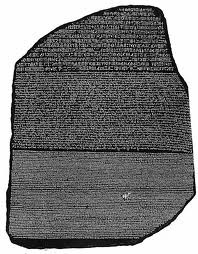
History tells that a French soldier discovered a stone where a message had
been sculpted in three different languages. The Rosetta stone, as it was 
later called, provided the key to translate the hieroglypic texts.
As I am lately learning German, here's my own key stone:

Zuerst am Morgen klingelt der Wecker, dann schlafe ich noch zhen Minuten.
Ich stehe um sieben Uhr auf. Dann dushe, rasiere un putze ich meine Zähne. Danach früstücke ich um zwanzig nach sieben Uhr. Ich trinke en Kaffee mit Milch un ich esse ein Brötchen mit Butter und Marmelade. Ich ziehe mich um halb acht an. Dann rauche ich eine Zigarette. Ich gehe um zhen vor acht Uhr los. Ich nehme keinen Bus; ich gehe lieber zu Fuss. Danach fange ich die Arbeit um Viertel nach acht Uhr an. Am Vormitag mache ich eine Pause. Um halb drei komme ich nach Hause.Dann esse ich das Mittagessen.

Am Dienstag un Donnerstag lerne ich Deutsche. Am Wochenende mache ich die Deutsch Hausaufgaben. Am Mittwoch treffe ifch meinen Freund. Am Abendspiele ich mit den Computer oder ich sehe fern.  Schliesslich gehe ich ins Bett um zhen Uhr.

To start with, my alarm clock rings, then I sleep for ten more minutes. I wake up at seven o'clock. After that, I have a shower, shave myself and brush my teeth. Then, at about twenty to eight I have my breakfast. I usually drink a white coffee and eat a toast with a butter an jam  topping.I dress myself at half past seven I smoke a cigarrette. I leave  home at half past eight. I don't usually take a bus, I prefer walking. I start work at quarter past eight. Later on, I take a break. At half  past three I come back home. Once there, I have my lunch.

On Saturdays and Sundays I learn some German. At the weekend I also make my German homework. I meet my friends on Wednesdays. In the afternoon I play with my computer or I watch TV. To end up with, I usually go to bedat ten o'clock.
Any resemblance to real persons, living or dead, is purely coincidental.

Monday, 24 December 2012

British Car Plates


I have always wanted to know why car placard numbers were different in Great Britain.
I have found it out, but it turned out to be more difficult to understand than I thought.

Basically, the whole sequence of numbers and letters is divided into three sets:
  1. What I'll call a geographical locator: The first section of letters tell you where the car is from.
  2. A date locator: if card get their plate between March and August, they just write the last two digits of the year, but it the plate is made between September and February, they get the same figure, plus 50 - don't ask me why -
  3. And last but not least, they write a set of three random sequence of letters. they don't include letters I, Q or Z.
This numbering method give the British people three major adavantages:
  1. You know when a car was made.
  2. In case of crime involvement, witnesses usually remember the area code.
  3. They have enough new codes until 2051 while the Spanish system can only cover until 2025. - but only if we are still buying cars by that time. -
FYI, I found this here, just in case you want to know more.

Tuesday, 13 November 2012

Power Distance

I had never thought of it, but once you twig the idea, you feel better with yourself as a teacher. When I was younger, it would have been impossible to shout in class or talk to other students when our teachers were speaking. In other words, the teachers were the authority in class. If they decided so, they would not repeat their explanations and they would not tell us how they made out their assessment calculations. We were invited to leave the classroom - sometimes forever - if our teachers decided we were misbehaving.

This is nolonger true: teenagers decide now what they eat at home;  they have their own properties - mobile phones, video games, etc. - and they argue with their parents if they disagree with  their opinions. Of course this is also happening during lesson periods. Our students tell us aloud if we say or write something wrong in class, they want to check their exams and they ask us how we made our assessment calculation - even if they aren't right at all - . Thus, we could state that Spanish people are getting used to freedom. The problem is parents still demand the same explanations as their sons as daughters: they both, parents and their siblings want to have meetings with teachers to make decisions about teachers' work. Needless to say that they always want to have positive marks at the end of each term - it doesn't matter if they worked hard or not -. 

Due to our education, we tend to be as flexible as we can, but you see, the supervising process we are going under is making the whole stuff really difficult.

No more complaints this time. Thanks to Speak Up magazine for the nice article at number 327.